Bokamoso Landscape Architects and Environmental Consultants
Attention: Lizelle Gregory
Dear Lizelle,
Salbu Experimental Radio Station - DV Larsen
Environmental Scoping Report For Road 2382
Please include the attached documents in an addendum to the EnvironmentalScoping Report
For Road 2382 under the heading Salbu Experimental Radio Station -DV Larsen.
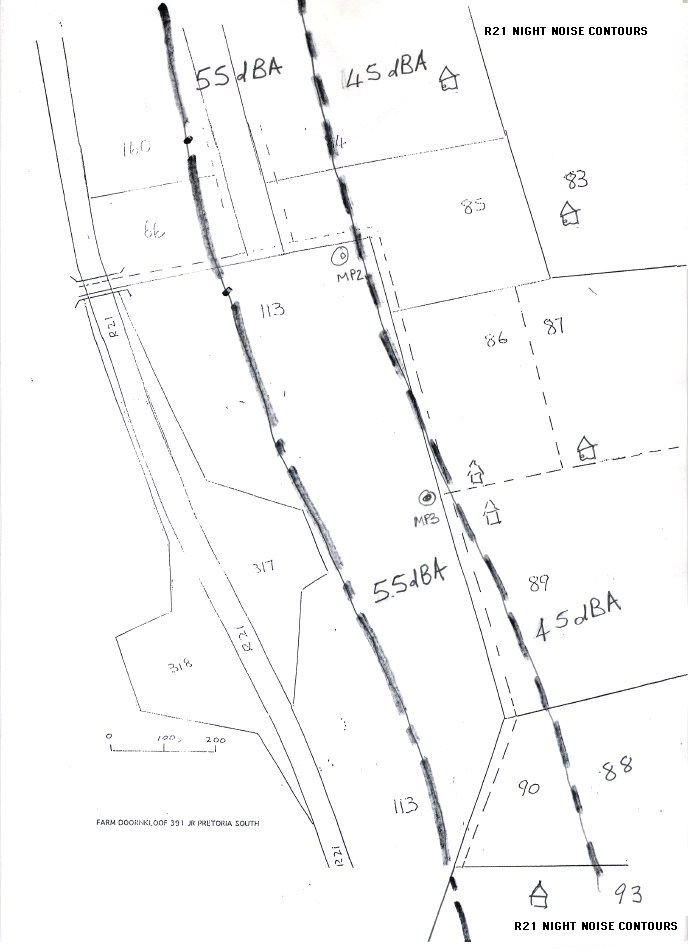
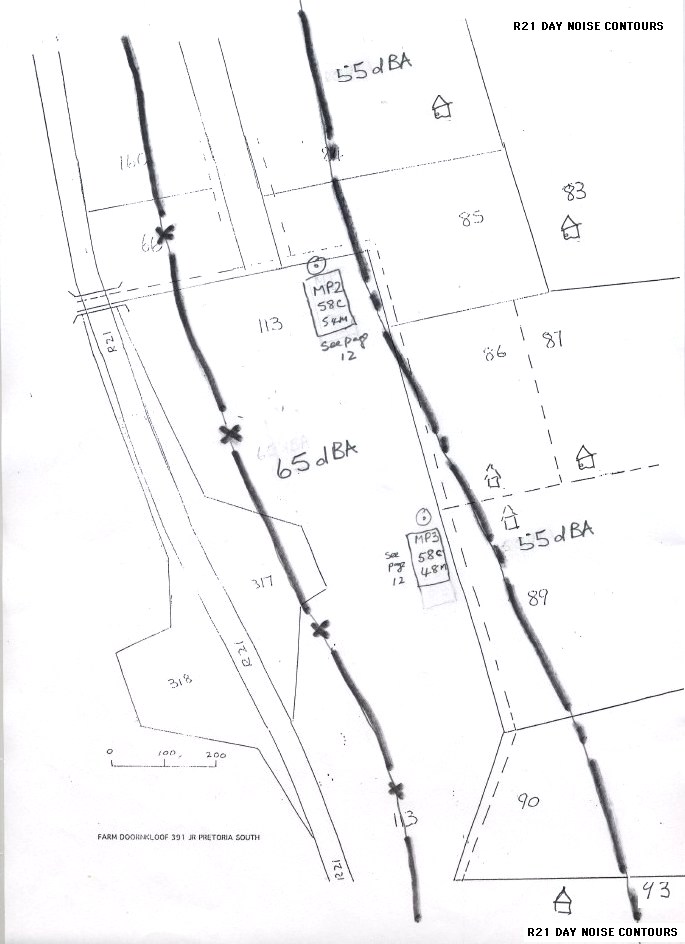
The attached are only approximate noise contours and I look forwardto seeing Dr Ben van Zyl 's noise impact studies.
I trust that Dr Ben van Zyl will address ALL of the possible routesand provide us with present, and future, noise impact
contours for All of the properties.
Thank you for your assistance in this matter. I look forward to yourfurther advice and instruction.
Yours sincerely,
David Larsen, SSAS, Pr Eng, MSAIEE, SAAI
Monday, 21 March, 2005
==========================================================
Telephone: +27-11-316-1393
Mobile: +27-82-821-2202
Fax : +27-88-011-316-1393
Post: PrivateBag X2352 Wingate Park, 0153, South Africa.
==========================================================
Subject: DKOA_Bokamoso_Gautrans_Road2382EIA: Noise Figures_050312 UPDATED
Date: Sat, 12 Mar 2005 14:53:25+0200
From: David Larsen - Salbu <salbu@icon.co.za>
Organization: SALBU
To: Neil Malan <nmalans@hermanus.co.za>
CC: Raymond Rausch<rsquared@mweb.co.za>
PLEASE SEE UPDATED ROAD NOISE CONTOURS ATTACHED
Dear Neil,
DKOA_Bokamoso_Gautrans_Road2382 EIA: Noise Figures _050312
Sorry for the delay in replying to your email. In the last few daysI have had a good look at the Road 2382 Scoping Report.
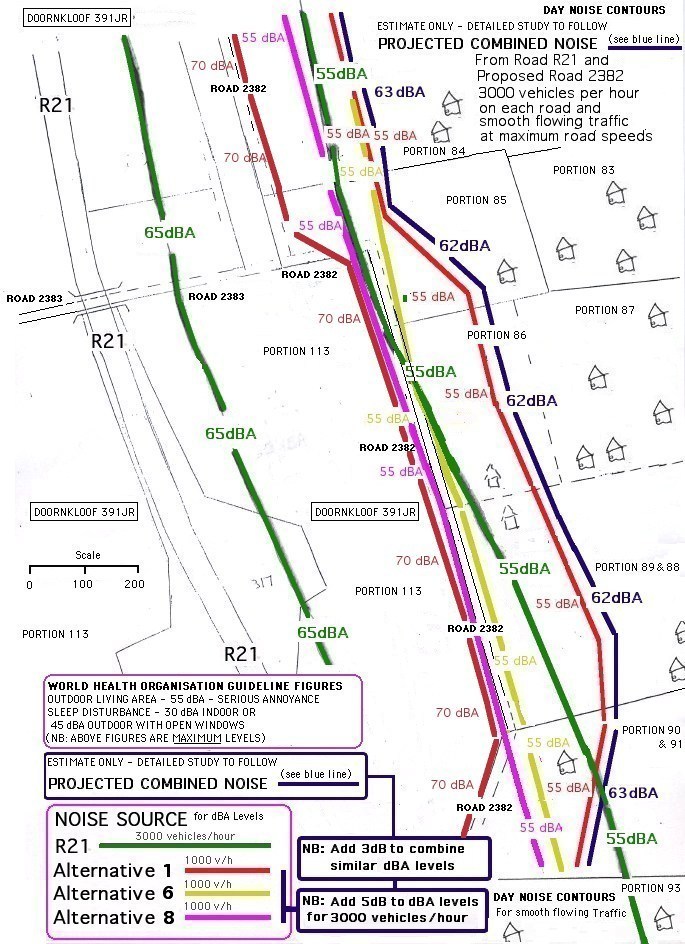
Should this road go ahead, as proposed, all the properties to the eastof road R2382 (Sterkfontein Avenue) will not be suitable
for residential purposes due to the very high level of vehicle noise.See attached file: NoiseDay_Alternatives_B.jpg
The projected road noise level would exceed the maximum levels laiddown by the World Health Organisation (WHO) by more
more than 10x and DACEL (Gauteng Provincial Government Department ofAgricultural, Conservation, Environment and Land
Affairs ) would not allow residential development on these properties.
The fact that the properties are much higher than the road may makethe use of large earth 'berms', covered in indigenous trees,
very expensive and may not be considered a viable option by Gautrans.
Seems we are being asked to exchange intolerable levels of dust fromthe road for intolerable levels of road noise :-)))
I look forward to your comments.
Kind regards,
David
PS: The projected noise level on the properties would be farin excess of 55 dBA
The WHO guideline states that at noise levels of 55 dBA, and above,serious annoyance occurs and speech becomes difficult.
==========================================================
David Larsen - Salbu
HomePage: http://www.salbu.com
Telephone: +27-11-316-1393
Mobile: +27-82-821-2202
Fax : +27-88-011-316-1393
Post: PrivateBag X2352 Wingate Park, 0153, South Africa.
==========================================================
PROJECTED COMBINED ROAD NOISE - FROM ROADR21 AND PROPOSED ROAD 2382
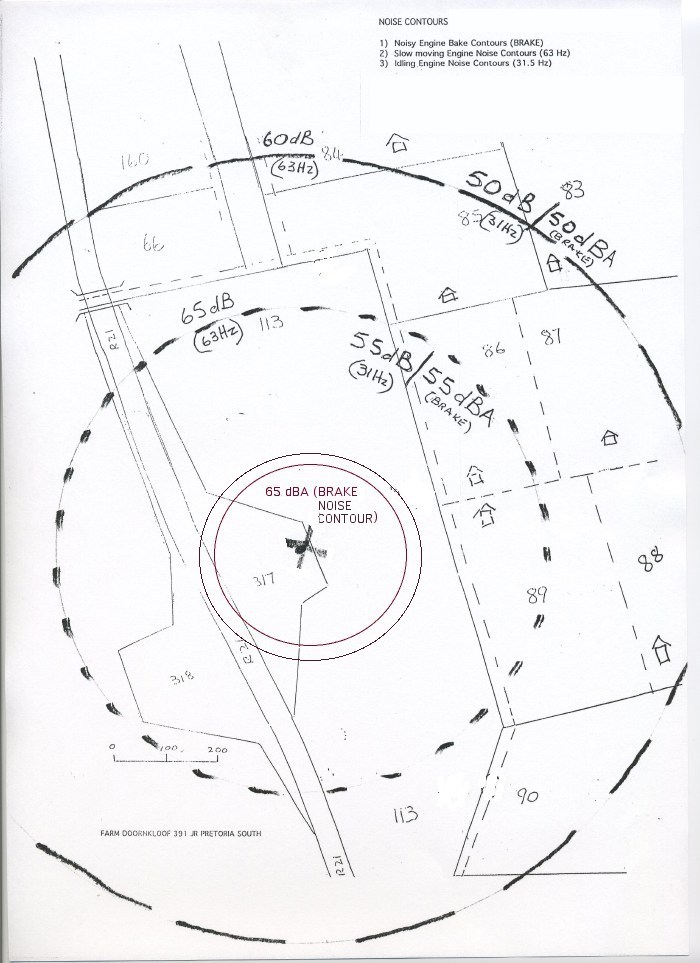
Low Frequency Noise ContoursThe low frequency noise contours (see below) should be centered onall intersections of the proposed Road 2382 and the impact of thisnoise should be assessed in terms of the World Health Organisation (WHO)recommendations with respect to the impact of Low Frequency noise on Humans
The noise contours clearly indicate that braking, idling acceleratingand slow moving trucks at the intersections of the Proposed Road 2382 willcause a very much higher level of atmospheric noise pollution onthe adjoining properties than more distant trucks travelling on the R21Freeway. It is important to note that the noise level will be far worse,than those shown in the diagram, under local inversion layer conditionsthat are characteristic of this area during the winter months.WHOGuidelines for Community Noise: Adverse health effects of noise: Sources with low-frequency components. Disturbances may occur eventhough the sound pressure level during exposure is below 30 dBA. Theevidence on low-frequency noise is sufficiently strong to warrant immediateconcern. Various industrial sources emit continuous low-frequency noise(compressors, pumps, diesel engines, fans, public works); and largeaircraft, heavy-duty vehicles and railway traffic produce intermittentlow-frequency noise. Low-frequency noise may also produce vibrations andrattles as secondary effects. Health effects due to low-frequency componentsin noise are estimated to be more severe than for community noises in general(Berglund et al. 1996). Since A-weighting underestimates the sound pressurelevel of noise with low-frequency components, a better assessment of healtheffects would be to use C-weighting. In residential populations heavy noisepollution will most certainly be associated with a combination of healtheffects. For example, cardiovascular disease, annoyance, speech interferenceat work and at home, and sleep disturbance. Therefore, it is importantthat the total adverse health load over 24 hours be considered and thatthe precautionary principle for sustainable development is applied in themanagement of health effects (seeWHO document Chapter 3).